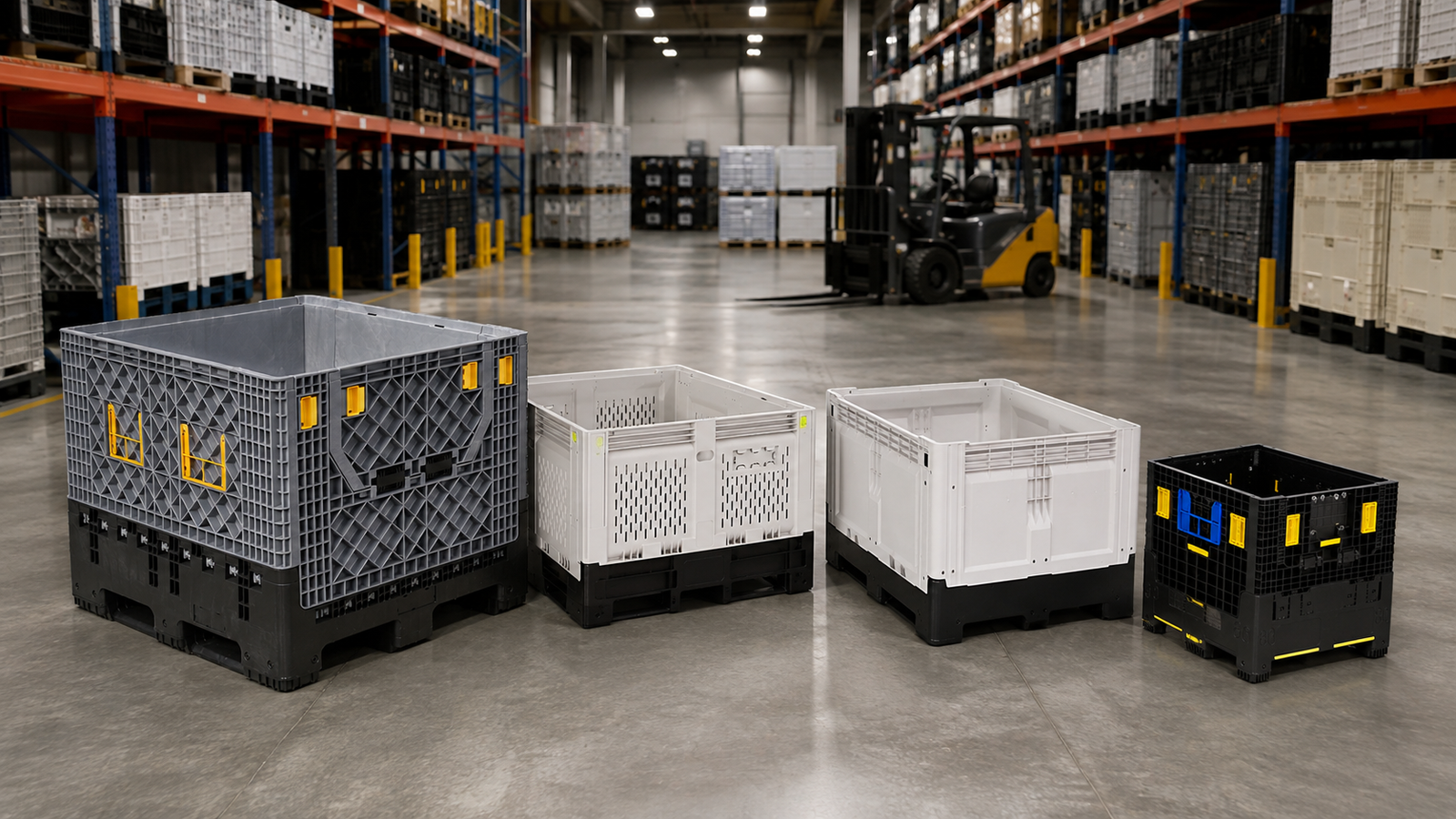
Choosing the right plastic pallet box size is the foundation of an efficient, cost-effective logistics system. This guide focuses on our three core footprints—1200×1000 mm, 1162×1162 mm (Australian standard), and 800×600 mm—to help you select the perfect box for your operation and drive faster, more reliable fulfillment.
Quick Comparison: Our Three Core Sizes
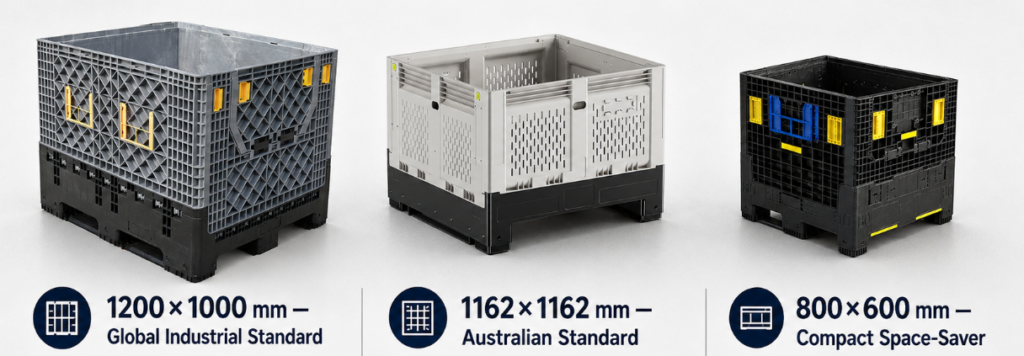
-
1200×1000 mm — The Global Industrial Standard
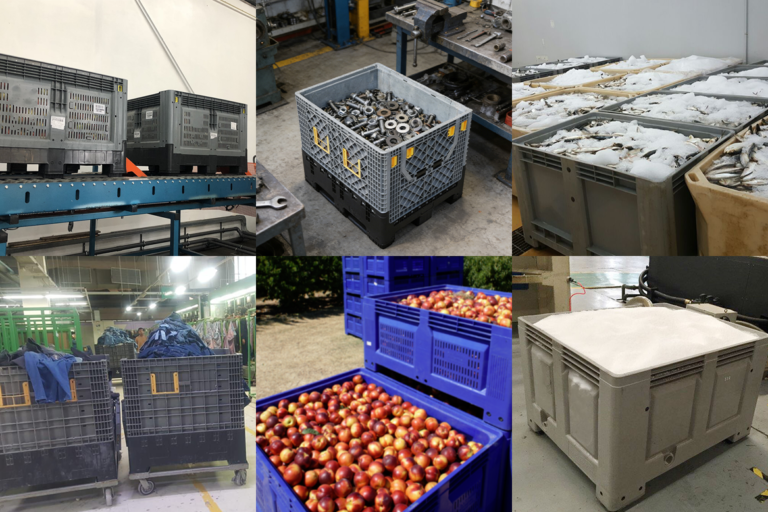
- Use Cases: Global manufacturing, food processing, general warehousing, recycling, and automotive.
- Core Advantage: Universal compatibility with containers and standard racking, maximizing volume.
-
1162×1162 mm — The Australian Standard
- Use Cases: Logistics to/from/within Australia, agriculture, and export.
- Core Advantage: Engineered to fit two-across in Australian rail containers, minimizing freight costs.
-
800×600 mm — The Compact Space-Saver
- Use Cases: Retail/e-commerce, small parts handling, pharmaceuticals, and tight operational spaces.
- Core Advantage: High spatial density, flexible for small-batch handling and modular stacking.
1200×1000 mm: The Global Standard Pallet Box
This is the workhorse of international logistics. Its dimensions are recognized globally, making it the safest and most efficient choice for businesses with diverse supply chains.
- External Dimensions: 1200 × 1000 mm
- Typical Internal Dimensions: Approx. 1110 × 910 mm (varies by wall design)
- Best For: Food processing, industrial manufacturing, recycling & waste management, automotive parts distribution, and general warehousing.
Core Advantages:
- Universal Compatibility: Seamlessly integrates with 20ft/40ft shipping containers, standard pallet racking, and automated handling systems worldwide.
- High Volume & Stability: Offers an excellent volume-to-footprint ratio, perfect for safely transporting bulk goods.
Buying Points:
- Verify Usable Volume: Always confirm the internal dimensions to ensure they accommodate your product and calculate the true usable capacity.
- Assess Stacking Design: Check the interlocking features on the top rim and base to ensure stable and safe stacking in your warehouse and during transit.
1162×1162 mm: The Australian Market Specialist
This size is purpose-built for one thing: conquering Australian logistics. It is the official Australian pallet standard, designed to eliminate wasted space in transit.
- External Dimensions: 1162 × 1162 mm
- Typical Internal Dimensions: Varies based on solid or ventilated design.
- Best For: Any business shipping to, from, or within Australia, especially in agriculture, food processing, and retail distribution.
Core Advantage:
- Optimized Freight Costs: Uniquely designed to fit perfectly two-across in Australian RACE (Railways of Australia Container Express) containers, maximizing your shipping spend.
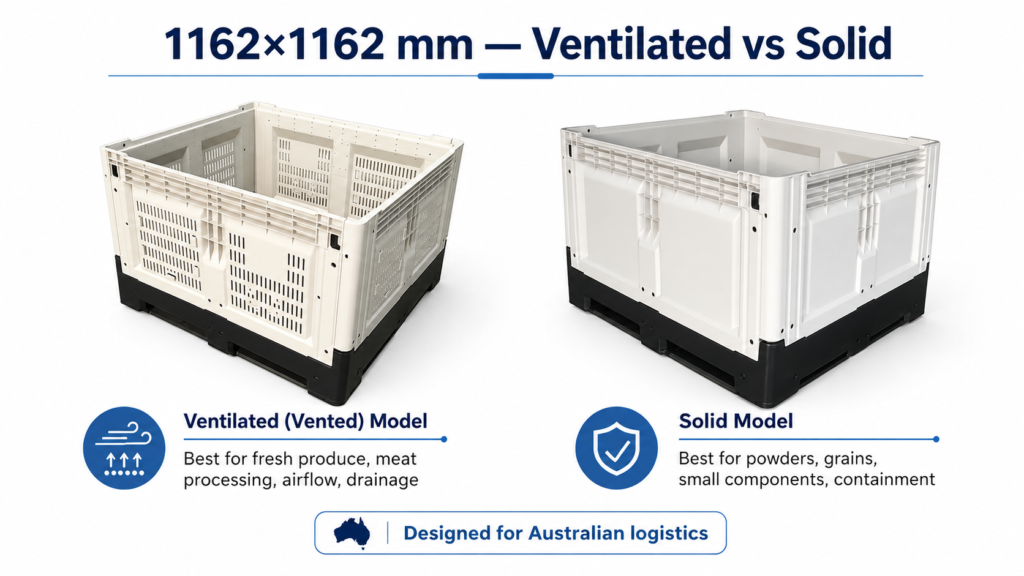
Version Options: Which is Right for You?
- Ventilated (Vented) Model: Features slatted walls and base for superior airflow.
- Ideal for: Cooling fresh produce like fruits and vegetables, draining liquids in meat processing, or preventing condensation.
- Solid Model: Offers a smooth, solid interior surface.
- Ideal for: Containing powders, grains, or small components; preventing leaks; and ensuring maximum protection from external contaminants.
Buying Points:
- Evaluate Your Product’s Needs: Do you need airflow for temperature control and preservation (Ventilated), or do you need total containment (Solid)?
- Match to Your Supply Chain: If your primary market is Australia, standardizing on this footprint is the single most effective way to reduce domestic freight costs.
800×600 mm: The Compact Choice for Precision and Density
When space is tight and agility is paramount, the 800×600 mm pallet box excels. It’s the ideal solution for small-item handling and last-mile logistics.
- External Dimensions: 800 × 600 mm
- Typical Internal Dimensions: Approx. 700 × 500 mm (varies by design)
- Best For: Retail and e-commerce fulfillment, small parts storage (kanban systems), pharmaceutical distribution, and navigating narrow production aisles.
Core Advantages:
- Superior Space Efficiency: Perfect for high-density storage and navigating areas inaccessible to larger boxes.
- Modular Flexibility: Two 800×600 mm boxes fit neatly on a 1200×800 mm Euro pallet, allowing for flexible, mixed-load configurations.
Buying Points:
- Calculate Load per Unit: Its smaller size means you must carefully assess the weight of your contents to ensure safe handling and stacking.
- Consider Combination Use: Plan how these boxes can be combined with your existing 1200×1000 mm inventory for optimized picking and sorting workflows.
Buyer’s Guide: Critical Factors Beyond the Footprint
Selecting the right footprint is only the first step. Use these factors to make a truly informed decision.
External vs. Internal Dimensions
- External: Dictates how the box fits in your truck, container, and racking.
- Internal: Dictates if your product actually fits and what your true usable volume is. Rule: Never finalize a purchase without confirming the internal dimensions.
Capacity vs. Load Rating
- Capacity (Liters): The theoretical volume. Be aware that structural elements like reinforcing ribs and rounded corners will reduce the usable volume.
- Load Ratings (kg): You must know all three:
- Static Load: Maximum weight when stationary on a flat surface.
- Dynamic Load: Maximum weight when being moved by a forklift.
- Racking Load: Maximum weight when supported on a pallet rack (this is often the lowest value).
Shipping Costs & Load Density
The right size directly reduces your cost-per-item-shipped. Our standard sizes are designed to maximize the floor space of shipping vehicles. A stable stacking design can double or triple your load capacity per square meter.
Standard Size vs. Custom
For 99% of applications, a standard size is the smarter choice.
| Choose Our Standard Sizes When: | Consider a Custom Size Only When: |
|---|---|
| ✅ You need proven compatibility & performance. | ⚠️ Your product is uniquely oversized. |
| ✅ You need fast delivery and lower MOQs. | ⚠️ Your automated system has rigid, non-standard specs. |
| ✅ You prioritize cost-effectiveness. | ⚠️ Your order volume is massive and provides a clear ROI on custom tooling. |
Final Selection Checklist
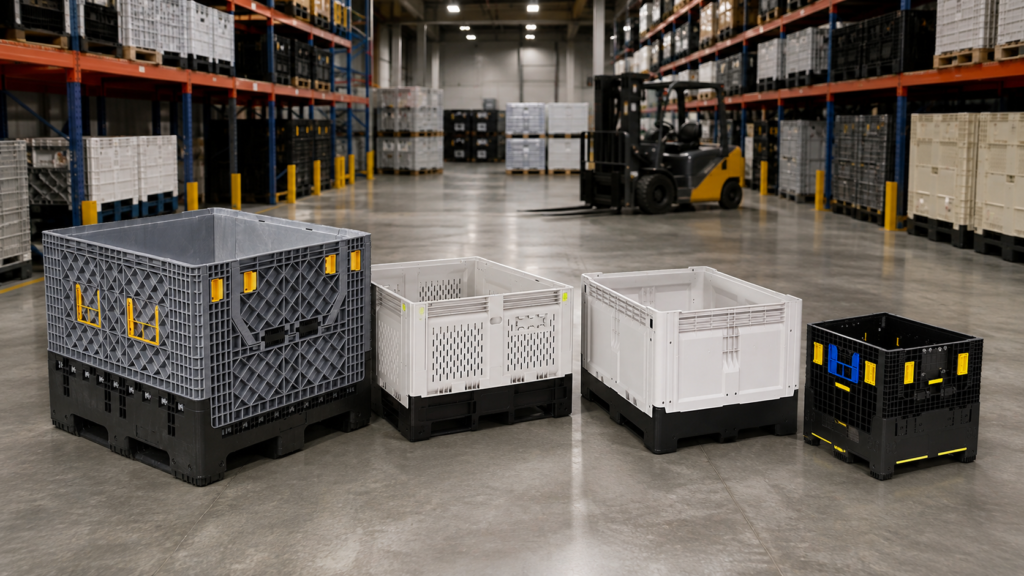
Use this list to prepare for a productive conversation with our sales team:
- Required Footprint: 1200×1000, 1162×1162, or 800×600 mm?
- For 1162×1162: Do you require the Ventilated or Solid version?
- Product Details: What are the dimensions and total weight of the contents per box?
- Handling Equipment: What type of forklifts and racking systems do you use?
- Stacking Requirements: How high will the boxes be stacked in storage and during transit?
- Need a Spec Sheet? We can provide detailed specification sheets for your records.
Frequently Asked Questions (FAQ)
1. What are the most common standard plastic pallet box sizes?
The three most strategic and widely used standard footprints are the 1200×1000 mm (global standard), 1162×1162 mm (Australian standard), and 800×600 mm (compact/half-Euro).
2. Why does Australia use the 1162×1162 mm size?
This specific dimension allows two boxes to fit perfectly side-by-side within standard Australian rail freight containers (RACE containers), maximizing space and dramatically reducing domestic shipping costs.
3. What is the difference between a ventilated and a solid pallet box?
A ventilated box has openings for airflow, crucial for cooling produce or draining liquids. A solid box is fully enclosed to contain small items, powders, or liquids and provide maximum protection.
4. How do I choose between a 1200×1000 and an 800×600 pallet box?
Choose the 1200×1000 for bulk goods, high-volume storage, and when maximizing capacity per unit is key. Choose the 800×600 for small parts, space-constrained environments, and operations requiring greater flexibility and modularity.